France, the World's Premier Vineyard
In both acreage and reputation, France remains the global benchmark for viticulture. 750,000 hectares of vines, over 350 recognized appellations, and an unmatched diversity of styles and terroirs anywhere on the planet.
A few staggering figures:
- 46 million hectoliters produced annually (2023), half of which is exported
- 80,000 wine estates — family operations, cooperatives, châteaux, independent winemakers
- 13 major wine regions, from the Rhine to the Pyrenees, from the Alps to the Atlantic
- A spectrum of styles ranging from Champagne to Muscat de Beaumes-de-Venise, from Sancerre to Cahors
But the true wealth of French winemaking doesn't lie in its legendary châteaux or prestigious labels. It lies in the thousands of independent winemakers who tend their land with care and offer exceptional bottles at accessible prices — often well below retail.
Buying direct changes everything: you pay fair value for the wine, you support a local producer, and you gain access to confidential cuvées that never reach commercial cellars.
Bordeaux and the Southwest: The Power of Tannin
Bordeaux — The Empire of Cabernet and Merlot
Bordeaux is the world's most renowned wine region. With 120,000 hectares and over 7,000 châteaux, the diversity is immense.
The major zones:
- Médoc (Pauillac, Saint-Julien, Margaux, Saint-Estèphe): Cabernet Sauvignon dominant, age-worthy wines with firm tannins, aromas of blackcurrant and cedar. Open after 8-15 years minimum for top cuvées.
- Saint-Émilion and Pomerol (Right Bank): Merlot dominant, rounder, more velvety wines, approachable earlier. Aromas of plum, truffle, chocolate.
- Sauternes and Barsac: sweet wines from noble rot (Botrytis), of absolute complexity. Honey, candied apricot, saffron. Can age for 50 years.
Grape varieties: Merlot (65%), Cabernet Sauvignon (22%), Cabernet Franc, Petit Verdot, Malbec (red); Sémillon, Sauvignon Blanc, Muscadelle (white).
Average prices: €8-25 for a good Bordeaux Supérieur when buying direct; €40-80 for a Cru Bourgeois; higher for Crus Classés.
Southwest — The Forgotten Vineyard
In Bordeaux's shadow, the Southwest is brimming with hidden gems.
- Bergerac: an extension of Bordeaux style, offering well-crafted, accessible wines
- Cahors: French Malbec in all its power — robust tannins, notes of violet and prune. A wine you absolutely must discover.
- Madiran: Tannat, the muscular grape of the Pyrenean foothills — rich in polyphenols, tremendous aging potential
- Jurançon: exceptional dry whites (Gros and Petit Manseng) and sweet wines
Bourgogne and Beaujolais: Finesse Above All
Bourgogne — The Reign of Terroir
Nowhere else in the world is the concept of terroir taken to such extremes. In Bourgogne, each plot — called a climat — is considered a unique entity. The hierarchy is unyielding: Regional → Village → Premier Cru → Grand Cru.
The major zones:
- Chablis: Chardonnay on Kimmeridgian soil, wines of razor-sharp minerality, notes of chalk and oyster shell. Drink within 3-10 years.
- Côte de Nuits (Gevrey-Chambertin, Vosne-Romanée, Chambolle-Musigny): the world's greatest Pinot Noirs. Structured, complex, built for the long haul.
- Côte de Beaune (Meursault, Puligny-Montrachet, Chassagne-Montrachet): the world's greatest Chardonnays. Rich, mineral, floral, incomparable.
- Mâconnais: accessible whites (Mâcon-Villages, Saint-Véran, Pouilly-Fuissé), excellent value for money.
Recent vintages to seek out: 2019 and 2020 for reds (warmth and concentration); 2022 for whites (freshness preserved despite the heatwave).
Beaujolais — Far More Than Nouveau
Beaujolais deserves serious rehabilitation. The Crus du Beaujolais (Moulin-à-Vent, Fleurie, Morgon, Juliénas, Chénas, Chiroubles, Brouilly...) are terroir-driven wines of great finesse, made from Gamay grown on granitic and volcanic soils.
A 5-year-old Morgon can resemble a red Bourgogne. An aged Moulin-à-Vent rivals many a Côte de Nuits.
Champagne, Alsace and the East: Between Effervescence and Aromatics
Champagne — The Art of Blending and Bubbles
Champagne produces the world's most imitated wine. Its secret: a precise blend of grape varieties (Chardonnay, Pinot Noir, Meunier), vintages, and different crus to create a consistent style — or an exceptional one in vintage years.
The styles:
- Blanc de blancs (100% Chardonnay): tension, finesse, citrus, chalk. Ideal with oysters and fish.
- Blanc de noirs (Pinot Noir and/or Meunier): structure, roundness, red fruits. Ideal with poultry and full-flavored dishes.
- Rosé: fruity, strawberry, redcurrant. Versatile, perfect for creative pairings.
- Vintage: only great vintages are declared. Exceptional complexity and aging potential.
Buying tip: independent Champagne growers offer bottles of quality comparable to major houses at 50-70% of the price. Look for RM (Récoltant-Manipulant) on the label.
Alsace — Seven Grape Varieties, Seven Characters
Alsace is the only French region that vinifies almost exclusively as single varietals. Labels therefore indicate the grape variety — a unique educational advantage.
- Riesling: the king of Alsace. Dry, taut, developing petrol notes with age, absolute minerality. The ultimate gastronomic wine.
- Gewurztraminer: floral, lychee, rose, utterly distinctive character. Ideal with munster cheese and spicy Asian cuisine.
- Pinot Gris: rich, smoky, amber-hued. Superb with foie gras and poultry.
- Muscat: rare, floral, dry. As an aperitif or with white asparagus.
- Pinot Blanc: supple, accessible, an everyday wine.
- Sylvaner: crisp, light, perfect with choucroute.
- Pinot Noir: the only Alsatian red — fruity, light.
Family-run Alsatian estates offer some of the best value in France. Favor small village domaines like those in Riquewihr, Ribeauvillé, Andlau.
Rhône Valley, Provence and Languedoc: Sunshine in a Bottle
Rhône Valley
Divided into two parts with contrasting styles:
Northern Rhône (Côte-Rôtie, Hermitage, Cornas, Saint-Joseph):
- Exclusively Syrah, powerful yet elegant wines, notes of pepper, olive, violet, smoked meat
- Some of France's most remarkable age-worthy wines (Hermitage > 20 years)
Southern Rhône (Châteauneuf-du-Pape, Gigondas, Vacqueyras, Côtes-du-Rhône):
- Blends based on Grenache, Syrah, Mourvèdre
- Warm, generous wines, ripe red and black fruits, garrigue, spices
- Gigondas and Vacqueyras offer far better value than entry-level Châteauneuf
Provence
Provence produces the world's finest rosé — and that's no accident. Limestone soils, the mistral wind, and exceptional sunshine create ideal conditions for dry, pale rosés with aromas of strawberry, white peach, and flowers.
- Bandol: an exceptional appellation. Reds based on Mourvèdre with tremendous aging potential (Domaine Tempier as a benchmark). Rosés of outstanding quality.
- Les Baux-de-Provence: winemakers often practicing biodynamics, in an extraordinary setting.
- Cassis: remarkable whites (Clairette, Marsanne) that are often overlooked.
Languedoc-Roussillon
France's largest wine region by area, long synonymous with mass production. But over the past 20 years, a quality revolution has been underway.
- Pic Saint-Loup: one of Languedoc's finest appellations, fresh and structured thanks to altitude.
- Saint-Chinian, Faugères: schist soils, garrigue, wines of character at gentle prices.
- Roussillon (Banyuls, Maury, Rivesaltes): unique vins doux naturels — oxidative, rich, to pair with chocolate and blue cheeses.
- Natural wines: Languedoc is the epicenter of France's natural wine movement. Dozens of experimental winemakers produce terroir-driven wines without additives.
Loire and Other Regions: Hidden France
Loire Valley — The Garden of France
From the source of the Loire to the Atlantic, the Loire vineyard stretches over 1,000 km and produces radically different styles.
From the Centre (upstream):
- Sancerre and Pouilly-Fumé: Sauvignon Blanc at its peak. Mineral, flinty, citrus, fresh-cut grass. A perfect match with Loire goat's cheese.
- Menetou-Salon, Reuilly, Quincy: lesser-known satellites, excellent value.
From Touraine (center):
- Vouvray and Montlouis-sur-Loire: Chenin Blanc across its full range — dry, off-dry, sweet, sparkling. One of the world's most complex grape varieties.
- Chinon and Bourgueil: light, aromatic Cabernet Franc, raspberry, violet, ripe bell pepper. The finest reds of the Loire.
From Muscadet (downstream):
- Muscadet Sèvre-et-Maine sur lie: the perfect match for Breton seafood. Crisp, saline, lees aging for a creamy texture.
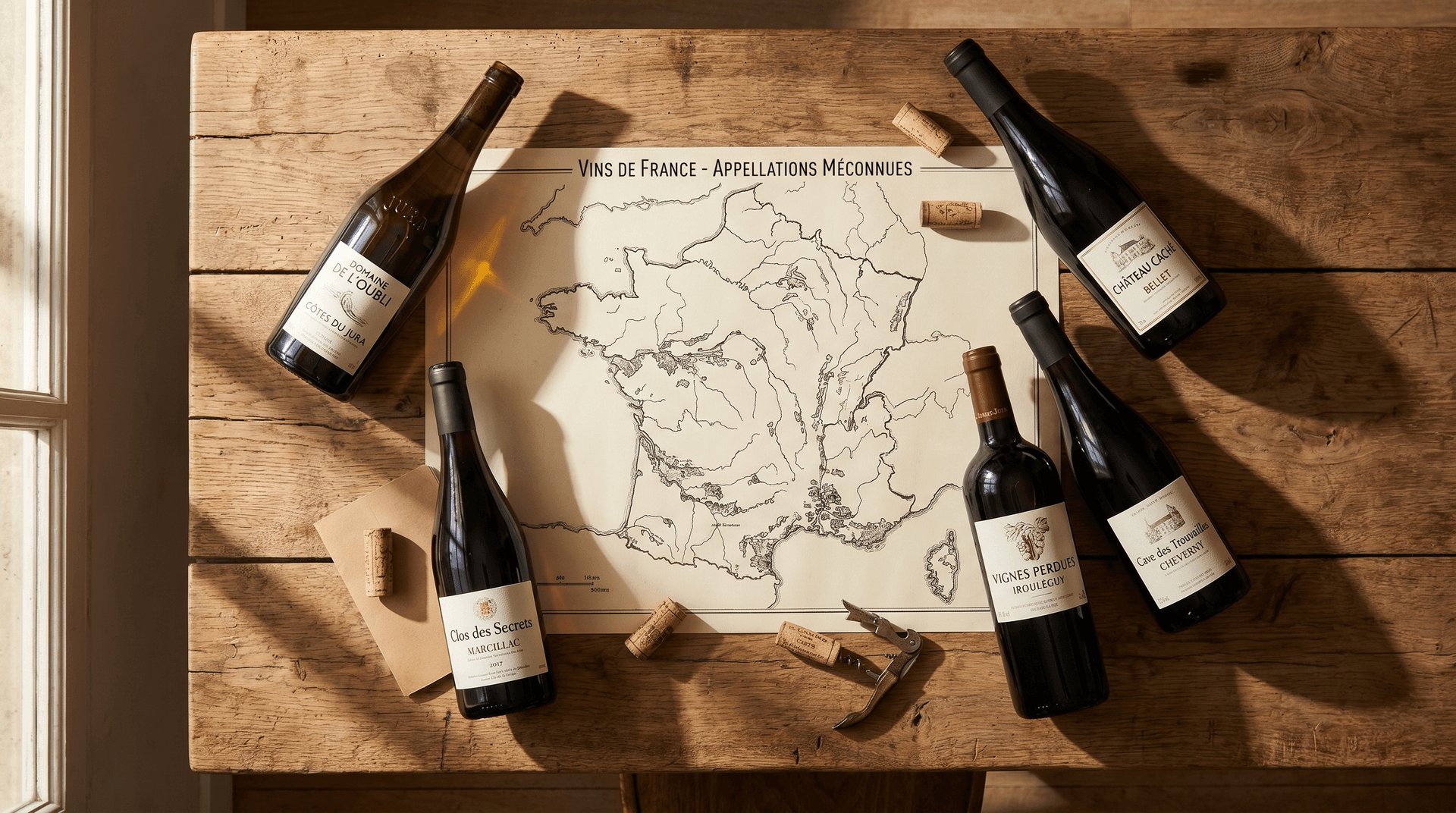
Confidential Vineyards to Discover
Jura — France's Switzerland. Vin jaune (Savagnin aged under a veil of yeast for 6 years), Poulsard, Trousseau — a palette found nowhere else in the world. Jura's oxidative wines pair with cheese like no other.
Savoie — Altitude wines. Altesse (Roussette de Savoie), Mondeuse, Jacquère — fresh, chiseled, ideal with fondue and fish from Alpine lakes.
Corse — A continent of aromas. Nielluccio (related to Sangiovese), Sciaccarello, Vermentino — wines of island character, maquis herbs, iodine, sun. Patrimonio and Ajaccio are the great appellations.
Your Next Bottle Awaits
Every region, every domaine has its own voice. On Spiravel, you can filter by region, grape variety, winemaking style — and order directly from the producer, with no middleman.