Why so many different labels?
The demand for 'clean' wines has never been greater. In ten years, sales of organic wines have tripled in France, the natural wine movement has gone from a confidential niche to a major trend, and biodynamics has gone from being an esoteric curiosity to a quality benchmark for sommeliers. Everyone wants to know what they're drinking. The problem is that between official certifications, self-declarations, marketing claims and private labels, the landscape has become totally illegible for the wine-lover.
This guide sets the scene. No endless nuances or technical jargon - just a clear explanation of what each label really guarantees, and what it does not. By the end of it, you'll know exactly how to navigate a shelf or a product sheet.
Organic wine (AB label / Eurofeuille) - what it really guarantees
European organic certification for wine has existed since 2012. It is official, controlled by independent third-party bodies (Ecocert, Bureau Veritas, Certipaq...) and governed by EC regulation no. 203/2012. What it bans in the vineyard: all synthetic pesticides, chemical herbicides and synthetic nitrogen fertilisers. What it authorises: natural plant protection products (copper, sulphur) and organic fertilisers.
In the cellar, the organic specification reduces the maximum doses of sulphur dioxide (SO₂) authorised: 100 mg/L for red wines (compared with 150 mg/L in conventional wine), 150 mg/L for whites and rosés (compared with 200 mg/L). Certain inputs remain authorised: selected industrial yeasts, enzymes, bentonite glues for clarification. Organic is a solid foundation, a real step forward compared with conventional - but it does not guarantee a 'zero additive' wine. Don't confuse certification with the total absence of human intervention.
Biodynamics (Demeter / Biodyvin) - beyond organic
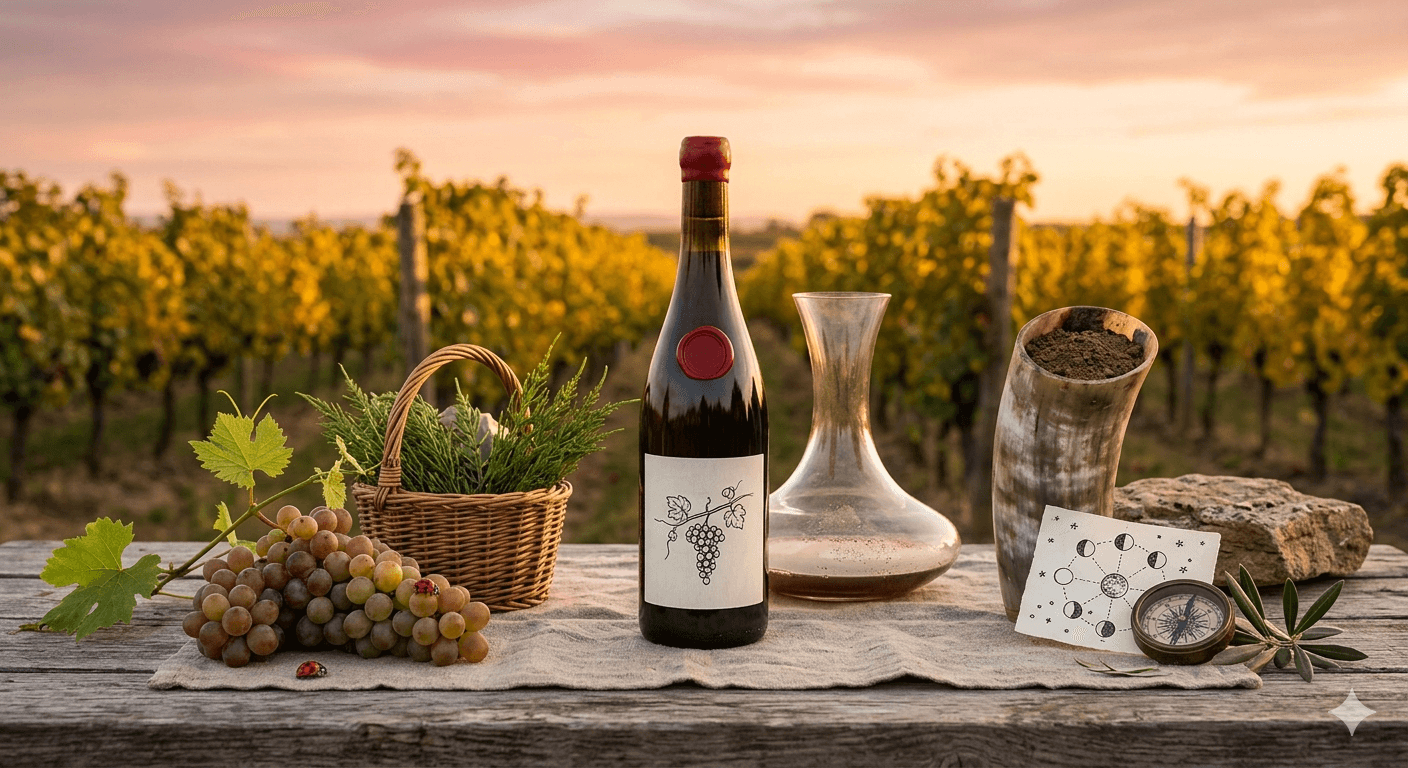
Biodynamic viticulture does everything that organic viticulture does not, and goes even further. It is based on the work of Rudolf Steiner (1924) and considers the vineyard as a living organism in its own right, in relation to astronomical cycles. In concrete terms: a lunar calendar for work in the vineyard and for tastings, biodynamic preparations (dynamised horn dung, pulverised silica, horsetail and nettle teas), a total ban on industrial yeasts, SO₂ reduced to the strict minimum.
Controversial among some scientists, biodynamic viticulture is defended with conviction by some of the world's biggest names in wine: Domaine de la Romanée-Conti in Burgundy, Zind-Humbrecht in Alsace, Nicolas Joly in Savennières, Chapoutier in the Northern Rhône. The Demeter certification (the strictest, with an international scope) and Biodyvin (a union of European biodynamic winegrowers) are the guarantees to look for on the labels. The proponents' argument is simple and hard to refute: the best biodynamic vintages are among the most expressive terroir-driven wines available, at all price levels.
Natural" wine - the freest and most vague of all
This is where things get complicated. There are no European regulations governing the term "natural wine". In France, since 2020, the union of natural method wines has obtained recognition of an official legal term: "vin méthode nature ", with two variants - with or without added sulphur (SO₂ < 30 mg/L total in the "without added sulphur" case). However, this term remains voluntary and is still in the minority. Most wines sold as "natural" carry no official label.
The basic principle is widely accepted in the movement: grapes grown organically or biodynamically + zero inputs in the cellar + no or very little added sulphur. In practice, however, the actual taste varies widely. From the sublime - terroir wines of rare precision and vitality - to the frankly unsuccessful, with shrunken, volatile or cloudy wines sold under the guise of being 'lively' and 'unfiltered'. Practical tip: buy natural wines from producers with established reputations, not from random labels. On Spiravel, the domain sheets detail the cellaring practices of each winemaker - so you know where you stand before you order.
HVE, Terra Vitis, Vignerons Engagés - the intermediate labels
Between conventional and certified organic, there is a range of intermediate labels that deserve to be better known.
HVE (Haute Valeur Environnementale): State certification created by the Ministry of Agriculture, based on three progressive levels. Level 3, the most demanding, covers biodiversity, phytosanitary strategy, fertilisation and irrigation management. It is less stringent than organic farming, but the requirements are real. Practical for helping estates make the transition to organic farming.
Terra Vitis: a sustainable agriculture label specific to winegrowing, with regional specifications. An intermediary between conventional and organic, it is a good first step towards greater commitment. Vignerons Engagés: CSR (Corporate Social Responsibility) certification that goes beyond the vineyard to encompass the estate's social, economic and environmental practices. A "Vignerons Engagés" estate may be involved in conventional agriculture, but it may also be exemplary in its human and local practices.
| Label | Nature | Scope | Level of requirements |
|---|---|---|---|
| AB / Eurofeuille | Official EU | Vine + Winery | ★★☆ |
| Demeter / Biodyvin | Private Certified | Vine + winery + terroir | ★★★★ |
| Cellar only | Demeter / Biodyvin | Demeter / Biodyvin | Private certified |
| HVE level 3 | Arrêté ministériel | Vigne uniquement | ★☆☆ |
| Terra Vitis | Cahier charges régional | Vigne | ★★☆☆ |
How to choose on Spiravel?
The good news is that you don't have to memorise all these distinctions before placing your order. On Spiravel, each domain record clearly displays the active certifications. You can use the Label filter in the wines catalogue to find organic producers certified AB, biodynamic Demeter or Biodyvin, or working using the natural method.
But here's the most important piece of advice in this article: the label isn't everything - the winemaker makes the difference. A passionate and attentive conventional winemaker can produce a cleaner, more expressive wine than a certified organic producer who botches his winemaking. Certification is proof of commitment, not a guarantee of taste quality. The best indicator is always the transparency of the producer's practices. On Spiravel, you can write directly to the producer to ask the question - and the best winemakers always reply.